 Ilayantech
How to Choose a Software Development Company in 2027: 12 Questions to Ask
Pay less attention to how polished the pitch is and more to the questions they ask you. Get clarity on who owns the code, how you will talk week to week, and what happens after launch. And if you can, start with a small paid first step before committing to the whole thing.
Learning how to choose a software development company is mostly about learning what to ignore. Picking who builds your software is one of the biggest decisions in the whole project, and it's easy to get wrong because every company's website says the same things. Passionate team, cutting-edge solutions, tailored to you.
Here are twelve questions that cut through that. They're grouped by what they help you learn, and each comes with what a good answer sounds like. If you're planning for 2027, they're worth keeping next to your brief.
Before you pick up the phone
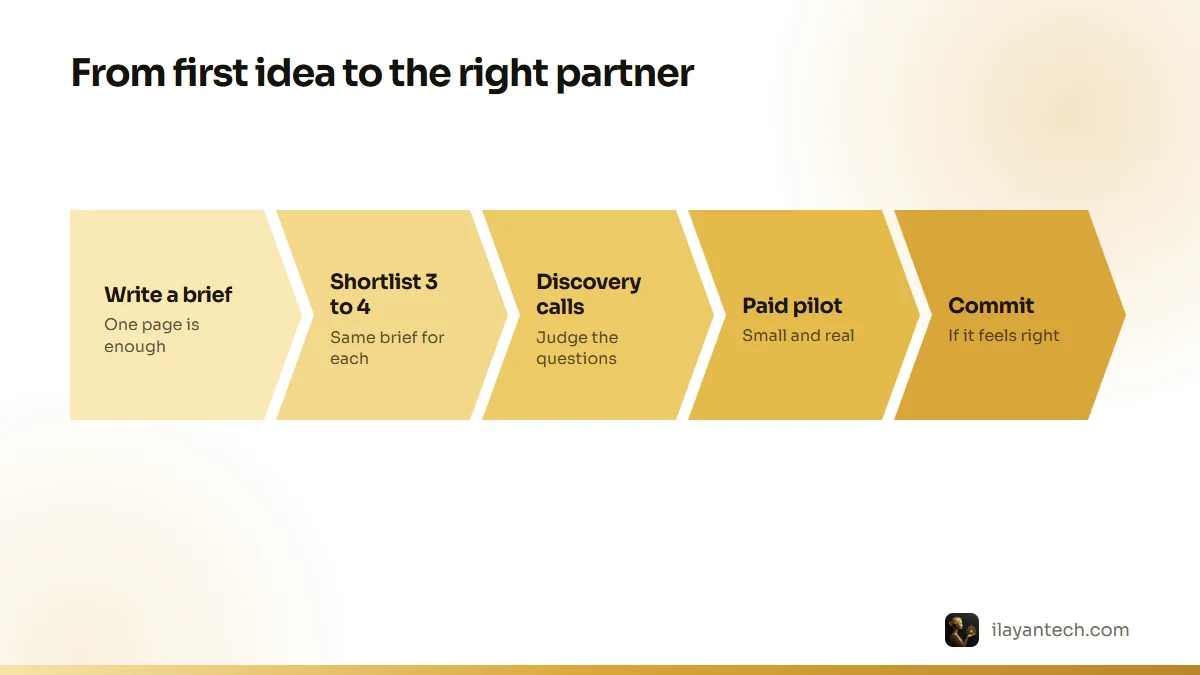
Write a one-page brief. What problem are you solving, who'll use it, what do you use today, what must it connect to? If you're still unsure whether you need custom software at all, start with custom software vs off-the-shelf software. A company that tells you honestly you don't need them is worth remembering.
It also helps to know roughly what you can spend. You don't have to share a number on the first call, but you should understand what moves the price. Our guide to custom software development cost will get you ready for that conversation.
Software company, freelancer or in-house?
You have three basic routes, and none is always right.
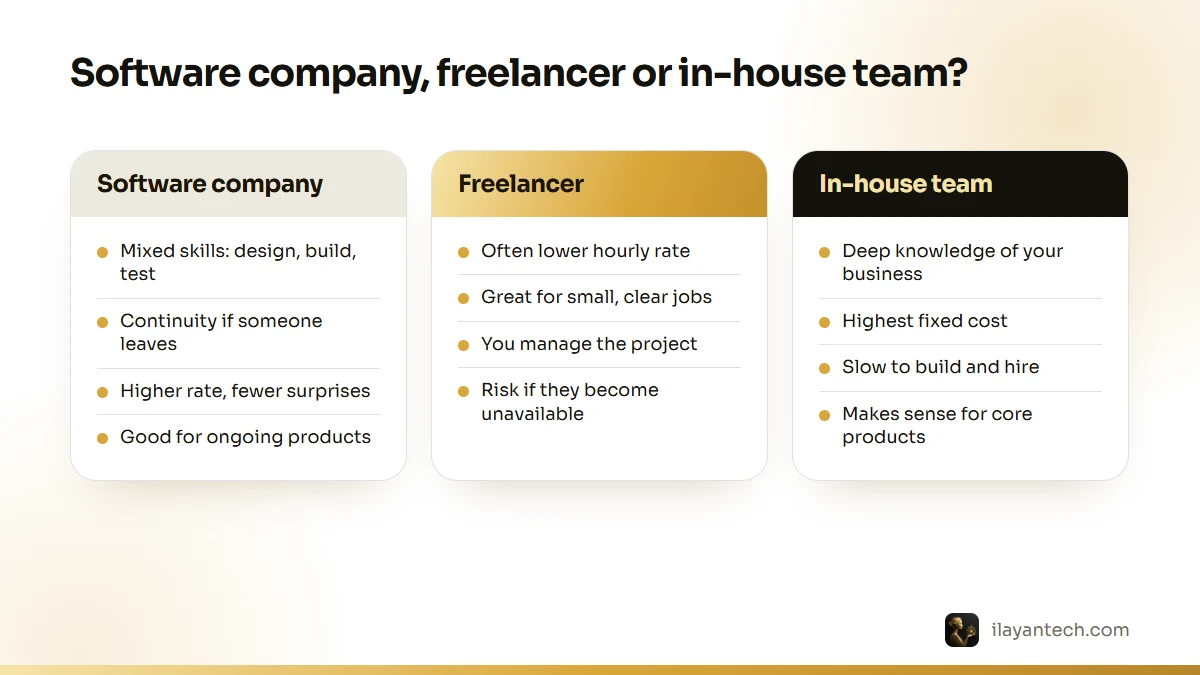
For a small, well-defined task, a good freelancer can be perfect. For a product your business will depend on for years, a team is usually safer, because design, testing, project management and support are covered, and the work doesn't stop when one person goes on holiday. Building an in-house team makes sense when the software is the core of what you sell.
How to choose a software development company: the 12 questions
Questions about the people
1. Can you show work like mine? You're not looking for a famous logo. You're looking for something similar in size or difficulty. Ask what the problem was and what changed for the client afterwards. Good teams talk about results. Weak ones list features.
2. Who will actually do the work? It shouldn't be a different group from the one in the sales meeting. Ask who the roles are, and how much of their time your project gets.
3. Can I talk to someone you've worked with? Ten minutes with a past client is worth more than any proposal. If they can't offer one, ask why.
Questions about how they work
4. How do you learn about my business first? The answer you want includes some kind of discovery: real conversations, a look at how things work today, and a written plan. "Send us your requirements and we'll start" should make you nervous, because nobody's requirements are complete.
5. How will we stay in touch? A regular rhythm, such as a short weekly update, one named contact, and a shared place for questions. Projects drift in the quiet gaps between meetings.
6. What happens when I change my mind? You will. Everyone does. A good partner has a simple process: they tell you what the change does to time and cost before you agree to it.
7. How do you test? You want to hear that testing happens throughout the build, not as a rush at the end, and what they do when a bug turns up after launch.
Questions about the boring stuff that matters
8. How do you protect our data? Listen for specifics: who can access what, how backups work, how sensitive information is handled. "We take security very seriously" isn't an answer.
9. Who owns the code and the data? You do. Get that in writing, along with access to the source code, the documentation and any accounts set up for the project. This one deserves to be uncomfortable if the answer is vague.
10. How is the price put together? Ask for it by phase or feature, and ask what isn't included.
Questions about the end
11. What happens after launch? Support, monitoring, fixes, updates, and what each costs. The best partners have thought about this before you ask.
12. What could go wrong with my project? This is our favourite, because the answer shows character. A confident team will name real risks, like unclear scope, tricky integrations or messy data, and say how they'd handle them. Be wary of anyone who says nothing can go wrong.
Comparing the proposals you get back
When two or three proposals arrive, resist the urge to jump to the price. Put them side by side and look at:
| What to compare | What a strong proposal shows |
|---|---|
| Understanding | Your problem described in your own words, with sensible questions |
| Scope | Clear phases and what's in each |
| Team | Named roles and their time on your project |
| Timeline | Milestones you can check, not just a final date |
| Price | Broken down, with what's excluded stated |
| After launch | Support and maintenance options and prices |
What to check in the contract
You don't need to be a lawyer to spot the essentials. Check that the agreement covers:
- The scope of each phase, and what "done" means
- How changes are requested, priced and approved
- Payments tied to milestones, not just dates
- That you own the code, the designs and the data
- Confidentiality of your business information
- Support after launch, and how long fixes are covered
- How either side can end the agreement, and what you get if that happens
If anything is unclear, ask a lawyer to read it. It's a small cost compared with a dispute later.
What a good company should ask you
Pay attention to the questions coming back at you. Good teams will ask things like:
- Who will use this every day, and can we talk to them?
- What happens today when this task goes wrong?
- Which parts are essential for launch and which can wait?
- What other tools or systems does this need to connect to?
- Who on your side will make decisions, and how quickly?
- How will you know in six months that this worked?
If a company moves straight to price and timelines without asking any of these, they are selling, not understanding. The more they ask early, the fewer surprises later.
Warning signs
None of these is automatic disqualification, but several together should slow you down:
- A fixed price and delivery date before anyone has asked detailed questions
- Can't explain their process in plain words
- Fuzzy answers about who owns the code
- No curiosity about your users or your goals
- Pressure to sign this week
- A price far below everyone else's, with no explanation
A lower-risk way to start
You don't have to commit to everything on day one. Try a short, paid first step: a discovery phase, or one small release. You'll learn how they communicate and what the work feels like for very little risk. If it goes well, carry on. If it doesn't, you've lost a small amount rather than a big one.
It also helps to know what a normal project looks like, so nothing surprises you. Our overview of the web application development process walks through each stage and what you'll be asked to do.
What good partnership feels like
After a few weeks, you should notice that they ask more questions than you expected, they explain trade-offs in plain language, and they tell you when something isn't worth building. You always know what's happening and what comes next. If one of these is missing, say so early. Good teams would rather hear it in week two than week twelve.
And if one of these questions made you think of a project of your own, tell us about it. We're happy to answer every question on this list.
Frequently asked questions
How many software companies should I talk to?
Three or four is plenty. Give each the same brief, speak to each for about the same time, and compare how they respond. The differences in the questions they ask will tell you more than the differences in the prices.
Local company or remote team?
Where they sit matters much less than how they communicate. Look for regular updates, working hours that overlap with yours, and someone you can actually reach. Plenty of great projects are run entirely remotely.
What should I prepare before the first call?
A page or less: the problem you want to fix, who will use the software, what you use today, anything it needs to connect to, and roughly when you need it. It doesn't have to be polished. Rough and honest beats perfect and late.
Would a freelancer be a better choice?
For a small, clearly defined job, quite possibly. For something you will rely on for years, a team usually gives you more continuity, a wider mix of skills like design and testing, and less risk if one person becomes unavailable.
What should be in the contract?
The scope for each phase, how changes are handled, payment tied to milestones, who owns the code and data, confidentiality, what support is included after launch, and how either side can end the agreement. If anything is unclear, ask a lawyer to check it.